January 6, 2026
From Ticketing System to Ticketing Ecosystem
Over the past few months, I’ve worked on two very different client projects that had one thing in common: both organisations were “considering a new ticketing system”.
On the surface, the process looked familiar. Demos, shortlists, comparisons, pricing discussions. The usual rhythm.
But stepping back after both projects, I realised something important had shifted.
Neither organisation was really choosing a ticketing system anymore.
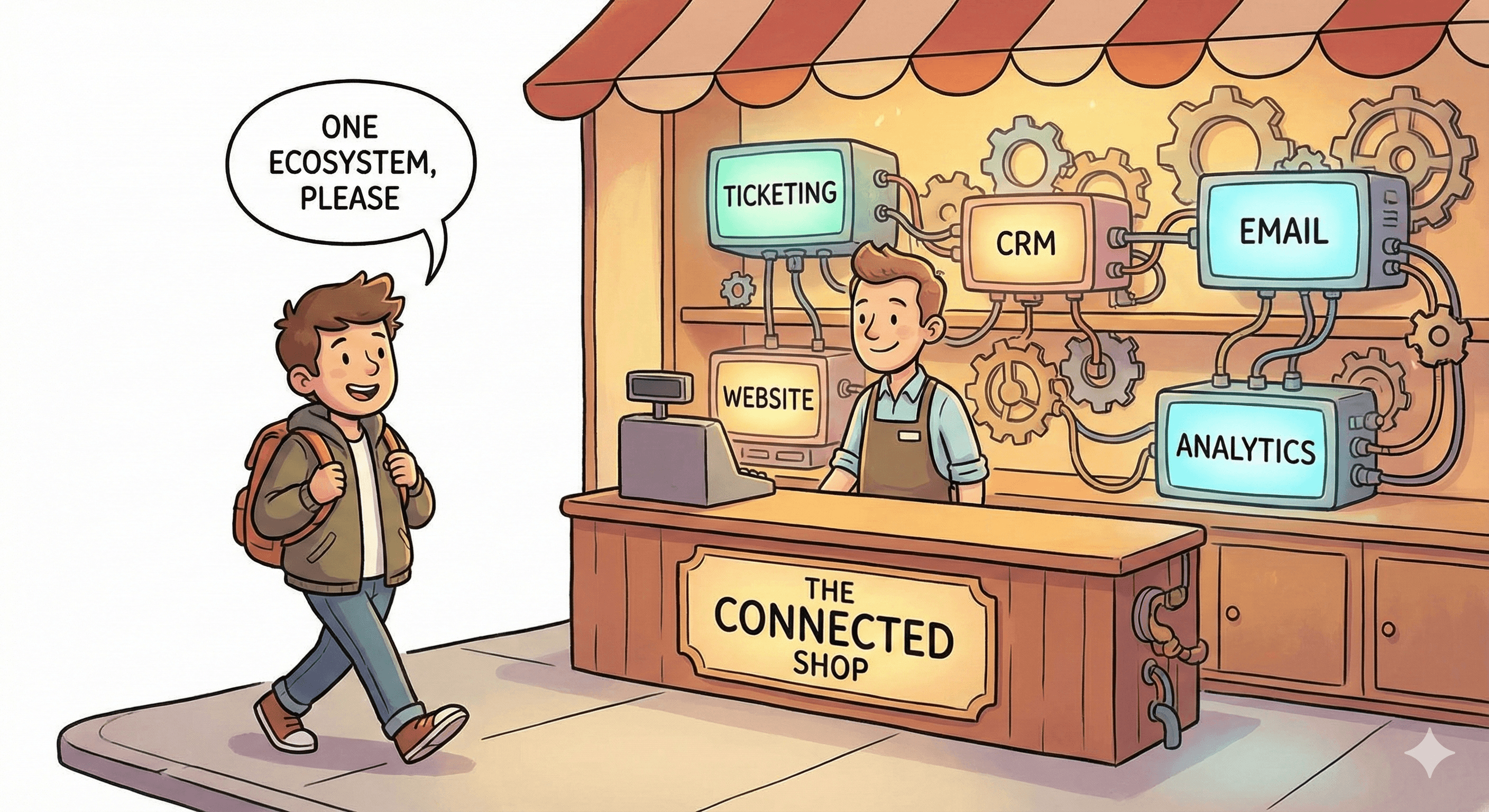
They were trying to define a ticketing ecosystem.
When core ticketing stops being the differentiator
There’s a reason this shift is happening.
Most modern ticketing systems are very good at the fundamentals. Selling tickets, handling seats, processing payments, managing box office operations - these capabilities are no longer rare or experimental. For many organisations, they’re table stakes.
That doesn’t mean all ticketing systems are the same. They aren’t.
Advanced capabilities still matter, and in some cases they matter a lot. Subscriptions, memberships, flexible packages, priority access, renewals, pricing logic - these features can be central to an organisation’s business model. For some, they’re a nice-to-have. For others, they’re non-negotiable.
But what has changed is where differentiation increasingly lives.
Even when advanced ticketing features are part of the evaluation, they’re now assessed alongside a much broader question: how well does this system fit into a connected whole?
Thinking beyond the platform
In both projects, the most important conversations weren’t about individual features. They were about how systems relate to each other.
Most organisations now think in terms of a core digital backbone: ticketing, customer data, marketing, venue operations, and insight. Sometimes analytics sits inside one of these systems, sometimes it’s separate - but the intent is the same. There needs to be a shared understanding of the customer and their journey.
Around that core, more specialised tools start to appear. Automation engines. Pre-ordering and hospitality solutions. Website platforms. Data and reporting layers. Each solves a specific problem, often far better than a generalist system trying to do everything.
And then there’s the revenue layer - the areas that directly affect yield and control. Owned resale. Ticket insurance. Single Sign-On. Dynamic or adaptive pricing. Membership logic that spans channels. Increasingly, organisations want to run these levers themselves, not hand them over entirely to a ticketing provider getting (at best) a fixed revenue share.
This is where the ecosystem mindset really shows its value.
A different way of evaluating ticketing systems
As a result, the key evaluation question has shifted.
It’s no longer just:
“What can this ticketing system do on its own?”
It’s increasingly:
“How does this system behave in an ecosystem?”
Does it integrate cleanly with specialist CRMs and marketing tools?
Is it comfortable being a source of transactional truth, rather than the owner of all customer intelligence?
Can advanced features like memberships or subscriptions coexist with external systems without friction?
This is why ecosystem-mapping approaches - like those championed by TicketingStack - are resonating right now. They reflect how organisations are actually making decisions, not how procurement documents have traditionally been written.
Designing the whole picture — without doing everything at once
One of the strongest patterns across both projects was this:
organisations don’t need to implement a full ecosystem on day one - but they do need to design it upfront.
The risk isn’t moving slowly. The risk is making early decisions in isolation.
If you choose a ticketing system without understanding how customer data, marketing, pricing logic, memberships, resale, and analytics might eventually connect, you often end up backing yourself into a corner. A few years later, you’re re-platforming not because the system failed, but because the ecosystem never quite came together.
The organisations that felt most confident weren’t the ones with the biggest budgets or the longest feature lists. They were the ones that had taken the time to sketch the full landscape - even if large parts of it were clearly marked “later”.
From ownership to orchestration
What’s emerging is a quieter but important shift in mindset.
Ticketing systems are increasingly expected to focus on what they’re best at: transactions, inventory, access, and - where relevant - sophisticated commercial constructs like subscriptions and memberships.
At the same time, organisations are taking a more active role as orchestrators. They decide where data lives, which system is the source of truth for which insight, and how different tools combine to support the customer journey.
It’s less about buying a single system that promises to do everything, and more about assembling a connected set of capabilities that can evolve over time, and deliver the desired results in their specific context.
A subtle but fundamental change
None of this feels dramatic when you’re in the middle of a project. It’s not a revolution. It’s an evolution.
But taken together, it represents a fundamental shift in how ticketing decisions are made.
Ticketing systems are no longer judged in isolation.
They’re judged by how well they integrate, how flexible they are, and how well they support a long-term ecosystem vision.
From what I’ve seen recently, this shift isn’t theoretical.
It’s already happening.